Sweat it Out: A Step-by-Step Beginner’s Home Workout Plan
Embarking on a fitness journey can feel daunting, especially when faced with the prospect of crowded gyms and unfamiliar equipment. Fortunately, the comfort and convenience of your own home offer a powerful alternative. This comprehensive guide will equip you with everything you need to design a successful beginner’s home workout plan, from understanding the profound benefits it offers to mastering essential exercises. We’ll break down the process step-by-step, ensuring you build a sustainable and rewarding fitness routine that fits seamlessly into your life.
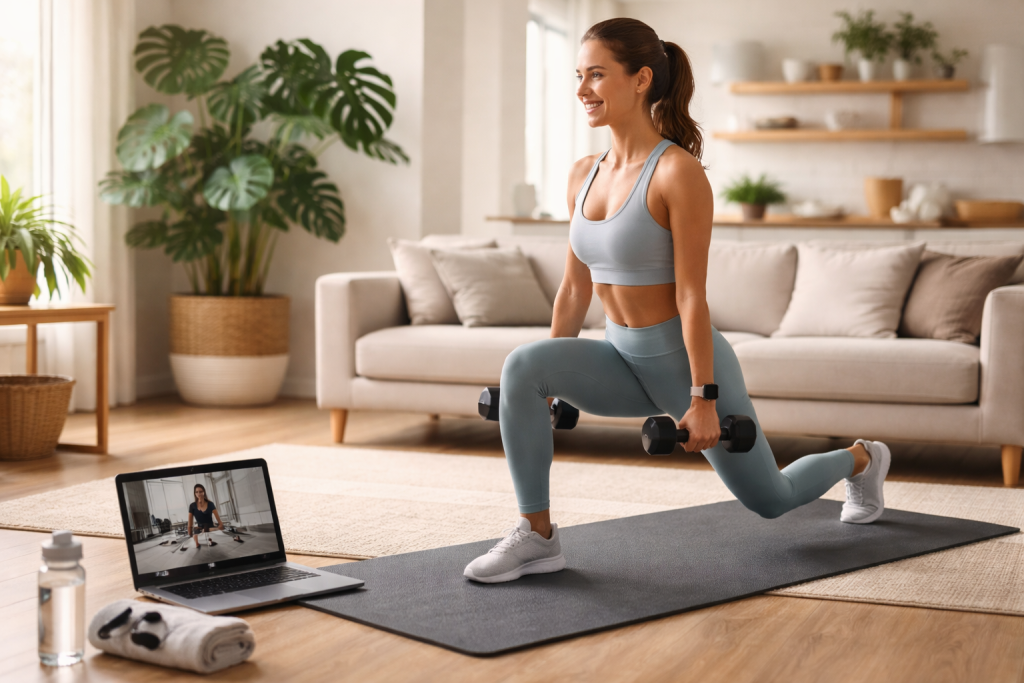
The appeal of exercising in the comfort of your own home surpasses simple convenience. Home workouts offer a unique set of advantages that can significantly impact your motivation, consistency, and overall enjoyment of physical activity. This accessibility is a powerful catalyst for change, removing many of the common barriers that prevent individuals from prioritising their health.
Contents
- 1 Time Efficiency and Flexibility
- 2 Cost-Effectiveness and Accessibility
- 3 Personalized Environment and Reduced Stress
- 4 Choosing the Right Location
- 5 Essential Equipment for Beginners
- 6 Creating a Motivating Atmosphere
- 7 Dynamic Warm-Up Movements
- 8 Static Stretching for Post-Workout Recovery
- 9 High-Intensity Interval Training (HIIT) at Home
- 10 Low-Impact Cardio Options
- 11 Fundamental Bodyweight Exercises
- 12 Incorporating Resistance Bands
- 13 Gentle Yoga Poses for Beginners
- 14 Pilates Principles for Core Strength
- 15 Gentle Static Stretching
- 16 Foam Rolling for Muscle Relief
- 17 Hydration and Nutrition
- 18 Rest and Sleep
Time Efficiency and Flexibility
One of the most significant advantages of home workouts is the unparalleled time efficiency they offer. Gone are the days of commuting to a gym, searching for parking, or waiting for equipment. You can simply roll out of bed and start your session, maximising your productive time. This flexibility allows you to exercise when it best suits your individual schedule, whether that’s first thing in the morning, during a lunch break, or after the kids are in bed. You are in complete control of your fitness timetable, eliminating the need to adhere to rigid gym operating hours or class schedules. This autonomy can be incredibly liberating and makes it easier to prioritise movement even on your busiest days.
Cost-Effectiveness and Accessibility
Setting up a home gym doesn’t require a hefty financial investment. While some equipment can enhance your workouts, many effective exercises can be performed with bodyweight alone or with minimal, inexpensive additions like resistance bands or a yoga mat. This drastically reduces ongoing membership fees and the associated costs of gym attire and transportation. Furthermore, home workouts are inherently accessible. You don’t need to worry about feeling self-conscious in front of others or navigating complex gym etiquette. Your home space becomes your sanctuary, fostering a sense of security and empowerment as you progress.
Personalized Environment and Reduced Stress
Your home environment can be tailored to your preferences, creating a comfortable and motivating space for exercise. You can control the music, the lighting, and even the temperature. This personalised approach can significantly reduce the stress often associated with public fitness environments. For individuals prone to anxiety or those who prefer a more private setting, home workouts offer a stress-free alternative that promotes a more positive relationship with exercise. The absence of external pressures allows you to focus solely on your body and your breath, fostering a deeper connection with your fitness journey.
Creating an effective and inspiring workout space at home doesn’t require a dedicated room or a significant overhaul. With a little creativity and organisation, you can transform even a small corner of your living room or bedroom into a functional fitness zone. The key is to make it inviting and practical, encouraging you to use it regularly.
Choosing the Right Location
Consider areas in your home that offer enough open space for movement. A clear patch of floor in your living room, a spare bedroom, or even a quiet corner can suffice. Ensure the floor is comfortable for exercises; if it’s too hard, consider adding a yoga mat or a small exercise mat. If you’re working with limited space, opt for foldable equipment that can be easily stored away when not in use. Natural light can also be a mood booster, so if possible, choose a location near a window.
Essential Equipment for Beginners
For beginners, the focus should be on a few versatile pieces of equipment rather than an overwhelming collection. A sturdy yoga mat is fundamental for cushioning your joints during floor exercises and providing grip. Resistance bands are incredibly effective for adding challenge to bodyweight exercises and can target various muscle groups. A jump rope is an excellent and affordable tool for cardiovascular training. As you progress, you might consider adding a set of dumbbells, starting with lighter weights, or a stability ball. Remember, simple can be incredibly effective, and mastering bodyweight exercises is a crucial foundation.
Creating a Motivating Atmosphere
Your workout space should be a place that inspires you to move. Consider adding some personal touches that make you feel energised. This could include a small plant, motivational posters, or artwork. Good lighting is also important; bright, natural light is ideal, but if that’s not possible, ensure your space is well-lit to enhance visibility and mood. Having your playlist readily accessible, whether through a speaker or headphones, can also contribute to a more enjoyable and focused experience. The goal is to create a sanctuary where you feel ready and eager to engage in your fitness routine.
Before diving into any workout, a proper warm-up is crucial to prepare your body for exertion, reduce the risk of injury, and enhance performance. Similarly, gentle stretching after your workout aids in recovery and improves flexibility. Prioritising these phases will make your entire fitness experience more effective and enjoyable.
Dynamic Warm-Up Movements
Dynamic stretches involve active movements that take your joints and muscles through their full range of motion. These are performed before your workout. Start with light cardio like brisk walking in place or gentle jogging for 5-10 minutes to elevate your heart rate. Then, incorporate exercises like
Arm Circles
Stand with your feet shoulder-width apart and extend your arms out to the sides. Begin with small circles forward, gradually increasing the size. After about 10-15 circles, reverse the direction and perform another set backward. Focus on controlled movements.
Leg Swings
Hold onto a wall or chair for balance. Gently swing one leg forward and backward in a controlled motion, keeping your core engaged. Perform 10-15 swings per leg. Then, swing your leg side to side, maintaining the same control and repetitions.
Torso Twists
Stand with your feet shoulder-width apart, knees slightly bent, and hands clasped in front of your chest. Gently twist your torso from side to side, keeping your hips relatively stable. Aim for 10-15 twists per side.
Static Stretching for Post-Workout Recovery
Static stretches involve holding a stretch for a sustained period, typically 20-30 seconds. These are best performed after your workout when your muscles are warm and more pliable. Focus on the major muscle groups you’ve worked. Examples include:
Hamstring Stretch
Sit on the floor with one leg extended straight and the other bent, with your foot tucked into your inner thigh. Lean forward from your hips, reaching towards your toes. Avoid rounding your back too much. Hold the stretch and repeat on the other side.
Quadriceps Stretch
Stand tall and hold onto a wall for balance. Grasp your ankle and gently pull your heel towards your glutes, feeling a stretch in the front of your thigh. Keep your knees close together and your torso upright. Hold and repeat on the other leg.
Triceps Stretch
Extend one arm overhead, bending your elbow so your hand reaches down your back. Use your other hand to gently press down on the bent elbow, deepening the stretch in your triceps. Hold and switch arms.
Cardiovascular exercise is essential for heart health, burning calories, and improving endurance. Fortunately, you don’t need a treadmill or elliptical machine to get your heart pumping. Many effective cardio workouts can be done with no equipment at all, making them perfect for beginners.
High-Intensity Interval Training (HIIT) at Home
HIIT involves short bursts of intense exercise followed by brief recovery periods. This method is highly effective for burning calories in a shorter amount of time and can be adapted for beginners. Start with a beginner-friendly HIIT routine that incorporates exercises like
Jumping Jacks
A classic for a reason, jumping jacks are a full-body cardio exercise. Perform them for 30 seconds with 15-20 seconds of rest in between intervals. As you get fitter, you can increase the duration of your work intervals or decrease resting periods.
High Knees
March or run in place, bringing your knees up towards your chest as high as possible. Focus on quick, rhythmic movements. Aim for 30 seconds of intense effort followed by a brief rest.
Butt Kicks
While running in place, bring your heels up towards your glutes. This movement will target your hamstrings and provide a cardiovascular challenge. Again, aim for short, intense bursts followed by recovery.
Low-Impact Cardio Options
For those seeking a gentler approach or recovering from an injury, low-impact cardio is an excellent choice. These activities elevate your heart rate without excessive stress on your joints.
Stair Climbing
If you have stairs in your home, they are an underutilised cardio machine. Walk or jog up and down the stairs at a comfortable pace. You can also incorporate variations like stepping up with one leg, then the other, and repeating.
Marching in Place with Arm Movements
This simple activity can be surprisingly effective. March in place, swinging your arms rhythmically. You can increase the intensity by marching faster or incorporating larger arm movements, like reaching overhead or bringing your elbows back.
Building strength is vital for metabolism, bone health, and overall functional fitness. For beginners, bodyweight exercises are an excellent starting point, as they allow you to learn proper form and build a solid foundation before adding external resistance.
Fundamental Bodyweight Exercises
These exercises target major muscle groups and are the cornerstones of a beginner’s strength training programme. Focus on controlled movements and proper form over speed or the number of repetitions.
Squats
Stand with your feet shoulder-width apart, toes pointed slightly outward. Lower your hips as if sitting back into a chair, keeping your chest up and your back straight. Aim to get your thighs parallel to the floor. Push through your heels to return to the starting position.
Lunges
Step forward with one leg, lowering your hips until both knees are bent at approximately 90-degree angles. Your front knee should be directly above your ankle, and your back knee should hover just above the floor. Push off your front foot to return to the starting position. Alternate legs for each repetition.
Push-Ups (Modified)
For beginners, performing push-ups on your knees is a great way to build upper body strength. Start on your hands and knees, with your hands slightly wider than shoulder-width apart. Lower your chest towards the floor, keeping your core engaged and your back straight. Push back up to the starting position. As you get stronger, you can progress to traditional push-ups from your toes.
Plank
The plank is an excellent exercise for core strength. Start in a push-up position, but rest on your forearms instead of your hands. Your body should form a straight line from your head to your heels. Engage your core and hold the position for as long as you can maintain good form, gradually increasing the duration.
Incorporating Resistance Bands
Resistance bands add versatility and challenge to bodyweight exercises. They are lightweight, affordable, and can be used for a wide range of movements, targeting both upper and lower body muscles.
Banded Squats
Place a resistance band around your thighs, just above your knees. Perform squats as usual, focusing on pushing your knees outward against the band. This activates your glutes and outer thigh muscles more effectively.
Banded Rows
Secure a resistance band around a sturdy object at chest height. Holding the ends of the band, step back until there is tension. Keeping your back straight and your core engaged, pull the band towards your chest, squeezing your shoulder blades together. This is a great exercise for your upper back muscles.
Yoga and Pilates are fantastic complements to traditional cardio and strength training, offering a unique blend of flexibility, core strength, balance, and mindfulness. They can help improve posture, reduce stress, and enhance body awareness, making them ideal additions to a beginner’s home workout plan.
Gentle Yoga Poses for Beginners
Yoga emphasises flexibility, balance, and breath control. For beginners, focusing on foundational poses will build a strong understanding of the practice.
Cat-Cow Pose
Begin on your hands and knees, with your wrists under your shoulders and your knees under your hips. Inhale as you drop your belly, arch your back, and lift your gaze (Cow pose). Exhale as you round your spine, tuck your chin to your chest, and draw your navel towards your spine (Cat pose). Move between these poses with your breath.
Downward-Facing Dog
From your hands and knees, tuck your toes, lift your hips up and back, forming an inverted V shape. Keep your hands shoulder-width apart and your feet hip-width apart. You can keep a slight bend in your knees and focus on lengthening your spine.
Warrior II
Step your feet wide apart and turn one foot out 90 degrees while the other points forward. Bend your front knee so it’s directly over your ankle. Extend your arms parallel to the floor, one reaching forward and the other back, with your gaze over your front fingertips. This pose builds strength and stamina.
Pilates Principles for Core Strength
Pilates focuses on strengthening the core muscles—the abdomen, back, and pelvic floor—which are essential for stability and injury prevention.
The Hundred
Lie on your back with your knees bent and your feet flat on the floor. Lift your head and shoulders slightly off the mat, extending your arms long by your sides. Begin to pump your arms up and down, keeping them straight. Inhale for five pumps and exhale for five pumps, repeating this for a total of 100 pumps.
Roll-Up (Modified)
Lie on your back with your legs extended and your arms overhead. Inhale and reach your arms forward. As you exhale, slowly roll your upper body up, one vertebra at a time, reaching towards your toes. Try to keep your lower back on the mat for as long as possible. Slowly roll back down with control. For beginners, stopping at a partial roll-up is perfectly acceptable.
The cool-down phase is just as important as the warm-up and the workout itself. It helps your body gradually return to its resting state, reduces muscle soreness, and promotes overall recovery. Neglecting this crucial step can lead to increased stiffness and a less enjoyable experience in future workouts.
Gentle Static Stretching
After your main workout, dedicate 5-10 minutes to static stretching. This is the ideal time to hold stretches for longer durations, targeting the muscles you’ve just worked. Focus on holding each stretch for 20-30 seconds with deep breaths. Prioritise stretches for your hamstrings, quadriceps, calves, chest, shoulders, and back. This helps to lengthen the muscles and improve flexibility.
Foam Rolling for Muscle Relief
Foam rolling can be a highly effective recovery tool for easing muscle tension and improving blood flow. Lie on a foam roller and use your body weight to slowly roll over tight muscles, pausing on tender spots for 20-30 seconds. Common areas to target include your quadriceps, hamstrings, calves, glutes, and upper back. It may feel a little uncomfortable initially, but the relief afterward is often significant.
Hydration and Nutrition
Proper hydration and nutrition are ongoing pillars of a healthy lifestyle and are particularly critical after a workout. Replenishing fluids lost through sweat is essential for muscle function and recovery. Drinking water before, during, and after your workout is paramount. Additionally, consuming a balanced meal or snack containing protein and carbohydrates within an hour or two of your workout can aid in muscle repair and energy replenishment. Opt for whole, unprocessed foods that provide the nutrients your body needs to rebuild and recover.
Rest and Sleep
Adequate rest is the foundation of muscle recovery and overall well-being. Your body repairs and rebuilds itself during sleep, so prioritising 7-9 hours of quality sleep each night is non-negotiable for consistent progress. Listen to your body and allow for rest days between more intense training sessions. Overtraining can lead to burnout, injury, and diminished results. Therefore, incorporating active recovery days, which might involve light walking or stretching, can be beneficial without putting excessive strain on your body. By embracing these simple yet powerful recovery strategies, you’ll enhance your fitness journey and ensure that every sweat session brings you closer to your goals.

GoLiveXora is managed by a passionate content creator dedicated to helping people improve their everyday lives through practical knowledge and modern solutions.